Overview – Why role switching?
In Bluetooth Classic (BR/EDR), every connection has two defined roles:
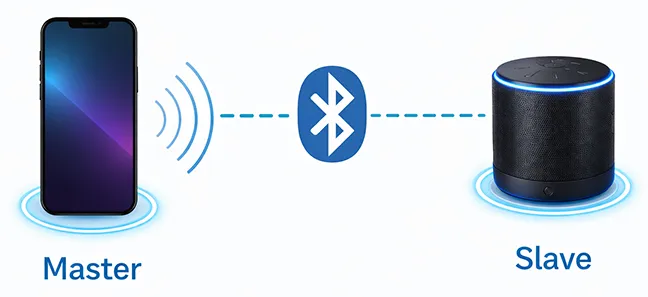
- Master – controls the timing (clock), frequency hopping sequence, and scheduling of packets
- Slave – follows the master’s clock and hopping pattern
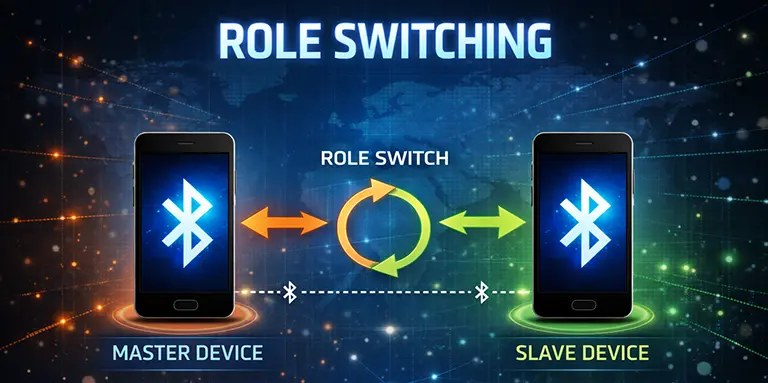
Role switching is the mechanism that allows two already-connected devices to swap who is the master and who is the slave without disconnecting. There’s several situations where this is necessary and we’ll cover them.
This article explains why role switching exists, how it works at the protocol level, when it should be used, and what tradeoffs it introduces, with practical guidance for embedded, desktop, and mobile implementations.
Bluetooth Classic Roles
Bluetooth Classic was designed around frequency-hopping spread spectrum (FHSS) with a master that is:
- A single clock authority
- A single hop sequence generator
- A central scheduler
The master device is always the device that controls all of this by controlling the clock (CLKN), Frequency hop sequence, Time slot allocation, and the polling order for slaves.
Meanwhile, slave devices synchronize to the master’s clock, follow the master’s hop sequence, and transmit only when polled (or in assigned slots)
This architecture has the benefit of enabling low-cost radios, deterministic scheduling and tight timing control which is necessary for audio and other applications. The downside is that this introduces rigidity into the system. This is where role switching comes in.
Bluetooth Piconet Architecture

Bluetooth Classic creates a network architecture called a piconet that has 1 master and up to 7 active slaves. These slaves have no control over their connection and get their clock
What happens when a Slave device that’s connected to a master needs to connect to other devices?
Without role switching it will either:
- Form a Scatternet
- Disconnect from the Master, become the master and reconnect to all the slaves
Support for Scatternets is problematic in practice because many devices
- Some controllers limit number of active roles
- Some stacks disable scatternet support entirely
- Some allow it only in restricted configurations
Even more significant, having a device participate in multiple networks is challenging because the device needs to accommodate networks with different clocks and many devices. Meeting timing to accomplish this using a radio that can only transmit or receive on one frequency at a time can be a problem.
The second option in which the device disconnects and becomes the master is very problematic because doing this is disruptive and complex.
Role Switching was defined in the Bluetooth specification to avoid both of these problems – we can switch a device to a Master without
Challenges with Scatternets

We touched a bit on the topic of scatter nets, but let’s look more at why Scatternets are problematic. A Bluetooth radio can only be receiving or transmitting on one frequency at a time.
Bluetooth Classic allows a device to be a slave in one piconet and a master in another at the same time. This creates a structure known as a scatternet.
While scatternets are valid according to the specification, they are notoriously difficult to schedule efficiently. A device participating in multiple piconets has to rapidly switch hop sequences, meet timing requirements for each role, and time-slice its radio usage. This often results in increased latency and reduced throughput, particularly for audio traffic.
As a result, many real systems deliberately avoid scatternets. Instead, they use role switching to consolidate all connections under a single master whenever possible. This simplifies scheduling, improves reliability, and reduces power consumption in complex devices like phones and PCs.
Before of this every device has to
- Rapidly switch hop sequences
- Maintain timing accuracy across piconets
- Meet polling deadlines for each master role
This creates additional latency (when you can’t meet timing), adds to Scheduling overhead and makes the firmware much more complex – which has ramification in the firmware size in the devices flash, etc.
Scatternets are one of the less used features of Bluetooth, because even though in theory they seem to solve a lot of issues, in reality the introduce issues:
- Reduced throughput – the radio has to jump across frequencies and the more links it has to service, the less it can allocate to each
- Higher Latency – similar to throughput, servicing links may require increasing latency
- Audio glitches – the latency and addition issues ends up causing audio glitches that are very noticeable to users
Role Switching
Rather than forcing devices to disconnect and reconnect in a different configuration, Bluetooth Classic allows two connected devices to exchange roles while keeping the link alive. This mechanism is fundamental to how phones, PCs, cars, and gateways behave in real products, yet it is rarely discussed outside of specifications and stack internals.
Bluetooth Classic connections are usually established during device discovery and paging, where speed and reliability matter more than long-term topology. As a result, many systems connect opportunistically, without knowing whether the connecting device will later need to manage additional peers.
For example, a phone may connect to a headset as a slave simply because the headset initiated the page. Later, the same phone may need to connect to a keyboard, a mouse, or a car infotainment system. At that point, remaining a slave becomes a disadvantage, because only a master can efficiently manage multiple devices within a piconet.
Without role switching, the only way to correct this would be to disconnect and reconnect—breaking audio streams, introducing latency, and degrading the user experience.
What Role Switching actually does
Role switching allows two already-connected Bluetooth Classic devices to swap master and slave roles without tearing down the ACL link. From the perspective of higher protocol layers—L2CAP, RFCOMM, AVDTP, HID—the connection remains intact.
Importantly, this is not a cosmetic change. The switch transfers clock authority and hop-sequence generation from one device to the other. Once the process completes, the new master fully controls scheduling and timing for that link. When implemented correctly, applications never notice that the switch occurred.
The most technically challenging aspect of role switching is the transfer of clock authority. Bluetooth timing is extremely tight; losing synchronization even briefly can cause packet loss or link failure.
To avoid this, role switching follows a carefully coordinated process. One device requests the switch, and if the peer accepts, both sides agree on a short time window—usually during low traffic—where the transition can occur. Data flow is temporarily reduced or paused while clock parameters are exchanged.
At the switch point, the former slave begins transmitting using its own clock and hop sequence, while the former master re-synchronizes as a slave. Normal traffic resumes once both sides confirm alignment.
In mature implementations, this entire process completes in tens of milliseconds. Poorly implemented stacks, however, may introduce audio glitches or short latency spikes during the transition.
How role switching is used in real products

In consumer electronics, role switching follows predictable patterns. Phones, laptops, and car infotainment systems often connect initially as slaves for speed and compatibility, then switch to master once the broader connection topology becomes clear.
Audio gateways frequently insist on becoming master so they can control polling intervals and ensure stable, low-latency streams. Simple peripherals such as keyboards and mice typically remain slaves permanently, because they neither manage other devices nor benefit from controlling scheduling.
These behaviors are rarely exposed to applications. They are handled by the Bluetooth controller and host stack based on policy decisions, role preferences, and current traffic conditions.
When to Use Role Switching
Role switching is most valuable when a device:
- Manages multiple Bluetooth Classic connections
- Aggregates or routes traffic
- Has real-time latency requirements (audio, control systems)
- Acts as a gateway or system controller
In these cases, choosing the correct master after connection establishment can significantly improve performance and reliability.
Conversely, role switching is unnecessary—and sometimes undesirable—for simple, single-purpose devices. For a basic HID device or accessory that only ever connects to one host, adding role-switch support increases complexity without providing tangible benefits.
Role Switching Power and Latency tradeoffs
The act of role switching itself has minimal power impact; it’s a short, infrequent operation. However, being a master typically increases ongoing power consumption due to higher scheduling responsibility and more frequent transmissions.
That said, masters also have the ability to optimize polling and reduce unnecessary idle listening, so the net power impact depends heavily on how well the stack is implemented.
From a latency perspective, a brief spike during the switch is expected. Long term, however, placing the “right” device in the master role often reduces latency and jitter, especially for audio and interactive traffic.
How to do a role switch
The actual procedure of a role switch depends on the stack. Some Bluetooth stacks allow you to request a role switch or configure the desired role and the stack will manage this automatically. The best way to understand how to perform a roles switch is usually given by the stack documentation of the device you’re using.
What about Bluetooth Low Energy?

Bluetooth Low Energy took a different architectural path. BLE fixes roles (central and peripheral) before connection establishment and avoids transferring clock authority mid-connection. Multi-device management is handled through independent connection intervals rather than shared scheduling.
This design was not accidental. It was a direct response to the complexity, fragility, and implementation burden introduced by Classic features such as role switching and scatternets.
Closing Thoughts
Role switching is not a legacy artifact or an optional curiosity—it is a core mechanism that makes Bluetooth Classic usable in dynamic, real-world systems. It allows devices to connect quickly, adapt intelligently, and optimize performance without disrupting users.
When used thoughtfully, role switching is invisible and beneficial. When misunderstood or poorly implemented, it becomes a source of glitches and instability.
Understanding why role switching exists and when it should be used is essential for anyone building or debugging Bluetooth Classic products today.