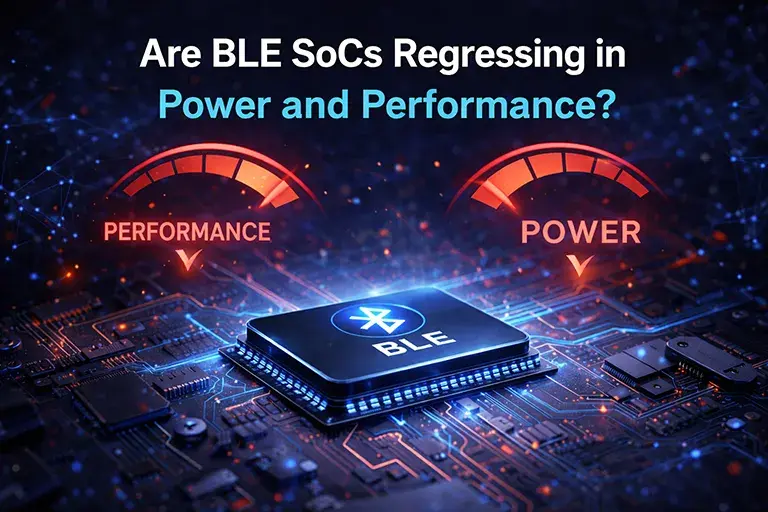
Bluetooth Low Energy (BLE) SoCs have long been defined by ultra-low power consumption and “good enough” performance for connected devices. But as modern BLE chips add faster CPUs, more memory, advanced radios, security engines, and multi-protocol support, many engineers are beginning to ask an uncomfortable question: are newer BLE SoCs actually regressing in power efficiency and real-world performance? In this article, we examine power consumption trends, performance tradeoffs, and architectural changes across recent Bluetooth Low Energy SoCs to understand whether today’s devices are truly improving—or quietly moving backward.
If you’ve been looking at some of the recent releases of BLE devices, you may have seen a lot of new cool parts being released by vendors. Although we typically expect an improvement in the device specification, there have been some interesting trends in which some of the specs of the BLE SoCs being released are not what they seem.
BLE SoC Generations
Over the last 16 years since Bluetooth LE was first released, we’ve seen a steady improvement in everything from performance (higher end ARM CPUs) to RF performance and a decrease in power consumption.
While the original CC2540 consumed close to 15-20mA and had -85dBm to –93dBm sensitivity, today’s devices are much better in practically every respect.
However over the last few years, some of the parts that have come out seem to have taken a step back in some parameters. Getting more and more out of the radios has become more difficult, and Bluetooth LE SoC vendors have had to make a lot of tradeoffs and strategic decisions in their parts.
Let’s look at a few notable examples where BLE device specifications may have surprised us.
Silabs Series 3 Power Consumption
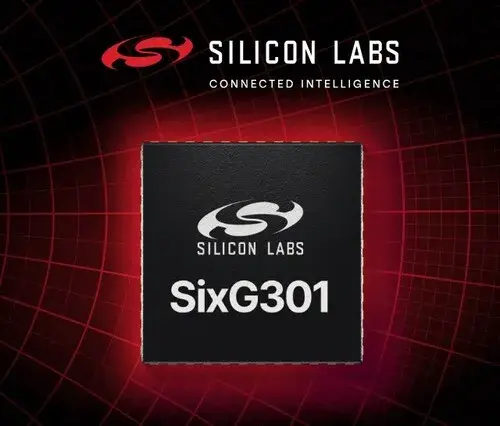
One of the more interesting cases we’ve seen recently are the SiMG301 and SiBG301 parts from Silicon Labs. These parts are their next generation Series 3 parts. Initially we were very excited when we saw the specifications for the huge amount of Flash and RAM (which makes multi protocol development easier).
But then, as we started digging into the specifications, we realized that not everything was as promising as it first appeared. Here’s some of the radio power specifications for the parts:
- 7.8 mA RX current (1 Mbps 2GFSK, EM1 @ 38.4 MHz)
- 11.1 mA TX current @ 0 dBm output power
- 28.2 mA TX current @ 10 dBm output power
Now let’s compare this to the EFR32BG26 which is part of Series 2:
- 5.4 mA RX current (1 Mbps 2GFSK, EM1 @ 38.4 MHz)
- 5.9 mA TX current @ 0 dBm output power
- 19.5 mA TX current @ 10 dBm output power
Or we can check the power consumption for EFR32BG24L parts:
- 4.4 mA RX current (1 Mbps GFSK)
- 5 mA TX current @ 0 dBm
It’s pretty clear that power consumption for the new Series 3 is much higher than expected. If you’re developing a BLE device that depends on low power consumption, you may be surprised, as we were, to see a 40%+ increase in RX and TX power consumption for what are supposed to be a new generation of chips.
Now, we should be realistic in considering that the BLE radio power consumption may or may not be the most significant factor in your application. If your product is spending most of their time in sleep states with occasional transmissions, like small sensors or beacons, then this current will dominate. But if you’re doing a lot of other processing, then the radio power consumption may not be as significant.
Now, the high amount of Flash and RAM for the Series 3, especially for the SiMG301, with its multiprotocol support is intended for devices that do more than just transmit some BLE data. So these parts may be more suitable for rechargeable devices with a large battery.
The Curious case of the nRF54Lxx
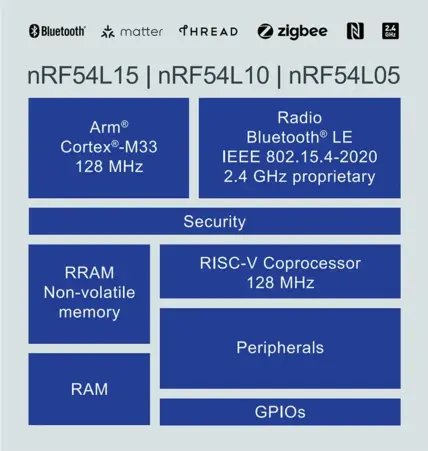
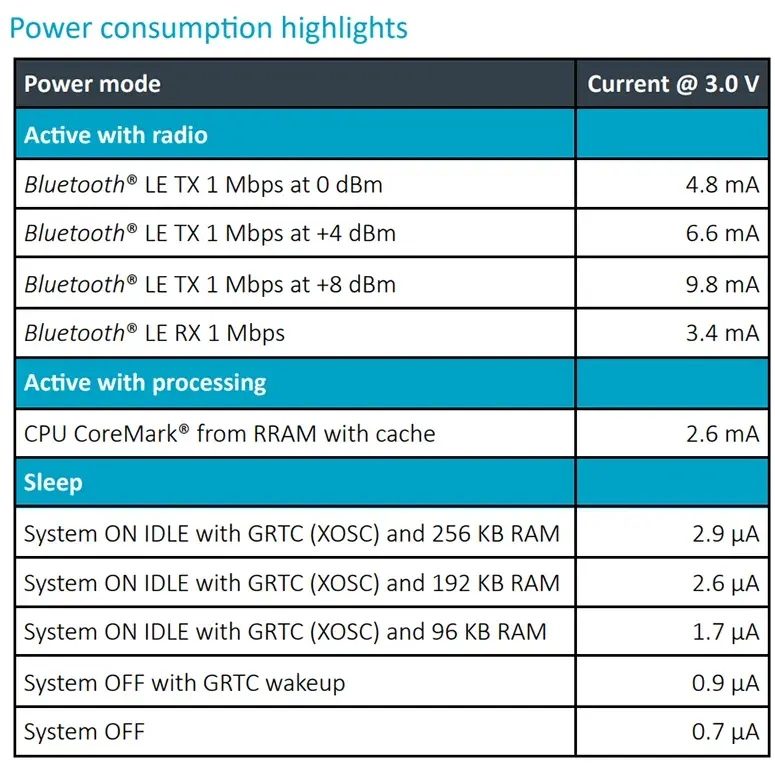
Another suprising thing we didn’t expect was the nRF54L15 radio. When Nordic announced the nRF54 series with the nRF54H20 radio, we were delighted to see the sensitivity specification was -100dBm. That would probably make it the highest sensitivity radio in the industry (short of tricks like temperature changes, etc). Though a few Silabs parts get very close, no one had crossed the -100dBm threshold.
As a point of comparison, the nRF53 series has roughly -98dBm sensitivity and some parts of the nRF52 series have -97dBm, though most are at -96dBm.
However, the nRF54L15, nRF54L10 and nRF54L05 only have -96dBm sensitivity. A 4dB decrease in sensitivity is quite a bit. Not catastrophic, but definitively not the level of performance we were hoping compared to other parts and the nRF53 which was at a very good -98dB.
Part of this decrease in sensitivity is probably because the part is being optimized for low power. The nRF54L15 consumes about 3.4mA in BLE RX 1Mbps and 4.8mA when transmitting. This is lower than the other Nordic BLE parts, so it likely traded off power consumption for sensitivity in the design.
Final Thoughts
Ultimately when choosing a Bluetooth LE SoC, it’s important to compare it thoroughly and find the right part. Even some newer parts may sacrifice some parameter for another, because engineering devices is ultimately all about tradeoffs.
Because it’s difficult to compare devices, we’ve created the BLE SoC Selector Tool which makes finding parts for your product much easier.