Introduction
As IoT devices continue to grow in homes, industrial systems, and commercial buildings, developers are facing a major challenge: how do you build a wireless network that scales well, consumes very little power, stays secure, and remains reliable even when hundreds of devices are connected?
Traditional wireless technologies like Wi-Fi work well for high bandwidth applications, but they’re often too power hungry for battery-operated sensors and embedded systems. Bluetooth Low Energy is excellent for short-range communication, but large always-on mesh networks can become difficult to manage depending on the application. Proprietary RF protocols solve some problems but create others, especially around interoperability and ecosystem support.
This is where OpenThread enters the picture.
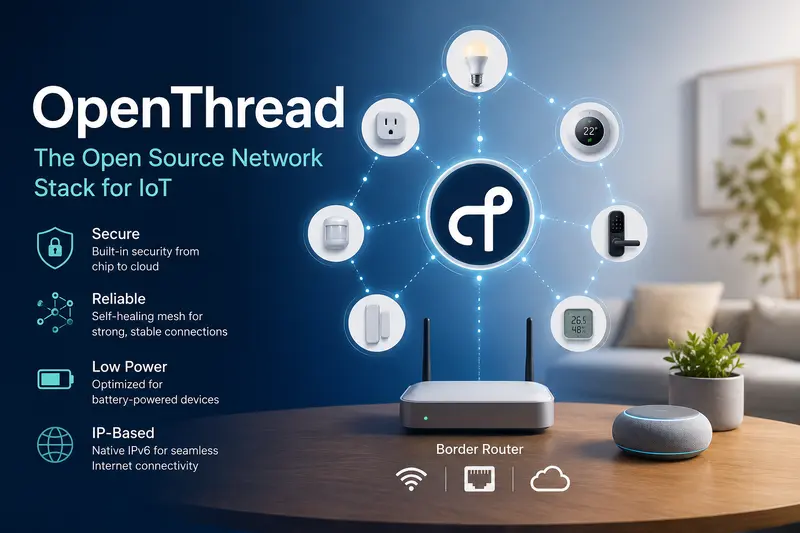
OpenThread is an open source implementation of the Thread networking protocol originally released by Google. It was designed specifically for low-power mesh networking and has become one of the most important technologies behind modern smart home ecosystems, industrial IoT systems, and connected embedded devices.
OpenThread is especially important today because Thread has become a foundational networking layer for Connectivity Standards Alliance Matter devices. Many next-generation smart home products now rely on Thread to provide reliable low-power IP connectivity between devices.
But OpenThread is more than just another wireless stack.
It combines IPv6 networking, self-healing mesh routing, low-power operation, built-in security, and scalable device management into a system that works surprisingly well on constrained microcontrollers. It also gives developers a production-ready implementation that runs across multiple RTOS platforms, radios, and hardware vendors.
In this guide, we’ll break down how OpenThread works, why it matters, how its architecture is structured, and where it’s commonly used in real products.
What Is OpenThread?
OpenThread is an open source implementation of the Thread networking protocol.
Thread itself is a low-power wireless mesh networking protocol built on top of IEEE 802.15.4 radios. The protocol was designed specifically for IoT systems that need:
- Low power consumption
- Reliable mesh networking
- Secure communication
- Native IPv6 connectivity
- Scalable device support
- Vendor interoperability
Unlike many proprietary IoT mesh systems, Thread uses standard Internet technologies including IPv6, UDP, and 6LoWPAN. That means Thread devices become real IP network participants instead of existing behind proprietary gateways and translation layers.
OpenThread provides the actual software stack developers integrate into embedded devices.
The project includes:
- Thread protocol implementation
- Mesh routing
- IPv6 networking
- Security layers
- Commissioning support
- Border router support
- Device management tools
- Simulation and testing environments
Because OpenThread is open source, developers can inspect the implementation, modify it, debug issues directly, and port it across platforms without being locked into a single silicon vendor.
The Relationship Between Thread and OpenThread
A common source of confusion is understanding the difference between Thread and OpenThread.
Thread is the networking standard, while OpenThread is one implementation of that standard.
This is similar to how TLS is a protocol standard while libraries like OpenSSL or NoxTLS are implementations of TLS.
The Thread specification defines:
- Device roles
- Routing behavior
- Security requirements
- Mesh networking operation
- Network formation
- Addressing mechanisms
- Commissioning procedures
OpenThread implements those behaviors in software.
Because the implementation follows the official Thread specification, OpenThread devices can interoperate with devices from other vendors that also follow the standard.
This interoperability has become especially important in the Matter ecosystem where products from different manufacturers are expected to communicate reliably.
Why Thread Was Created
To understand why OpenThread matters, it helps to understand the problems Thread was trying to solve.
Early smart home systems often depended on proprietary protocols. Devices from different vendors struggled to communicate with each other, mesh stability was inconsistent, and many systems required centralized hubs that became single points of failure.
Wi-Fi also presented challenges.
Although Wi-Fi provides high throughput and native IP connectivity, it consumes significantly more power than many sensor applications can tolerate. Battery-powered devices like motion sensors, door sensors, and environmental monitors needed something lighter.
Thread was designed to address these limitations.
The goals were straightforward:
- Use low-power radios
- Support large mesh networks
- Eliminate single points of failure
- Provide direct IP connectivity
- Maintain strong security
- Simplify interoperability
The result was a protocol that could run on relatively small embedded systems while still providing modern Internet-style networking capabilities.
OpenThread Architecture Overview
At a high level, OpenThread combines multiple networking layers into a complete embedded mesh networking stack.
The architecture typically looks something like this:
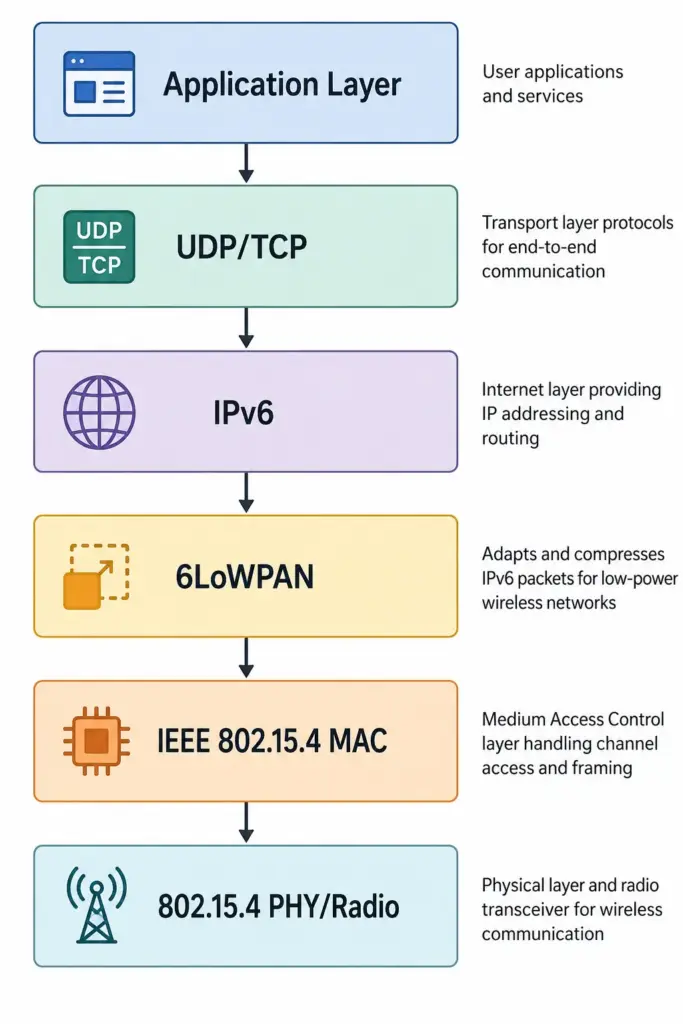
The interesting part is how OpenThread compresses and manages IPv6 networking over extremely constrained wireless links.
IEEE 802.15.4 frames are small compared to Ethernet or Wi-Fi packets. OpenThread relies heavily on 6LoWPAN to compress IPv6 headers and make packet transmission practical on low-bandwidth radios.
Despite these constraints, devices still participate as native IPv6 nodes.
That design decision is one of Thread’s biggest advantages.
IEEE 802.15.4 Foundation
Thread networks operate on IEEE 802.15.4 radios.
This standard defines the PHY and MAC layers used by many low-power wireless protocols including:
- Thread
- Zigbee
- WirelessHART
- 6LoWPAN
- ISA100.11a
802.15.4 focuses on low data rate communication with very low power consumption.
Typical characteristics include:
- 2.4 GHz ISM band operation
- 250 kbps data rate
- Short frame sizes
- Low transmit power
- Low-cost radio implementations
Compared to Wi-Fi, the throughput is much lower.
But for many IoT applications, throughput isn’t the primary concern. Reliability, battery life, and scalability matter far more than streaming large amounts of data.
IPv6 and 6LoWPAN in OpenThread
One of Thread’s defining features is native IPv6 support.
Each Thread device can have its own IPv6 address, allowing direct communication using standard Internet networking principles.
The problem is that IPv6 headers are relatively large compared to 802.15.4 packet sizes. A standard IPv6 header alone is 40 bytes.
On a constrained wireless link, that overhead becomes expensive quickly, but this is where 6LoWPAN becomes critical.
6LoWPAN stands for IPv6 over Low-Power Wireless Personal Area Networks and its job is to compress IPv6 headers and fragment packets efficiently so IPv6 communication becomes practical over small wireless frames.
Without 6LoWPAN, native IPv6 support on constrained radios would be extremely inefficient.
OpenThread heavily relies on 6LoWPAN compression mechanisms to keep network traffic small and power efficient.
Mesh Networking in OpenThread
Unlike star topologies where all devices communicate directly with a central hub, Thread uses mesh networking.
In a mesh network, devices can relay packets for each other.
This dramatically improves coverage and resilience.
If one routing path fails, the network can dynamically reroute traffic through other devices.
This self-healing behavior is one of Thread’s strongest features.
For example, imagine a smart building with dozens of sensors spread across multiple floors.
Some devices may be too far from the border router to communicate directly.
Instead, neighboring devices relay packets across the mesh until they reach the destination.
This approach extends network range without requiring high transmit power.
OpenThread Device Roles
OpenThread devices can operate in several different roles depending on their capabilities and power requirements.
Router
Routers forward traffic within the mesh.
They maintain routing information and help extend network coverage.
Routers are typically powered devices since they remain active continuously.
Examples include:
- Smart plugs
- Light switches
- Thermostats
- Fixed infrastructure nodes
End Device
End devices don’t route traffic for other nodes.
These devices communicate through a parent router.
This reduces complexity and lowers power consumption.
Battery-operated sensors commonly use this role.
Sleepy End Device
Sleepy End Devices are optimized for extremely low power operation.
They spend most of their time asleep and wake periodically to check for messages.
This allows devices to run for years on small batteries.
Common examples include:
- Door sensors
- Motion detectors
- Leak sensors
- Temperature sensors
Border Router
The border router connects the Thread network to external IP networks such as Ethernet or Wi-Fi.
This device acts as the bridge between the Thread mesh and the broader Internet.
Border routers are especially important in Matter deployments because they allow Thread devices to communicate with smartphones, cloud services, and other IP systems.
How OpenThread Forms a Network
Thread network formation is designed to be mostly automatic.
When devices join the network, they discover neighboring nodes and determine their role dynamically.
The network elects leadership roles automatically and adapts if nodes disappear.
This reduces administrative overhead significantly.
Unlike older mesh systems that required extensive manual configuration, Thread was built to self-organize.
That becomes extremely valuable in large-scale deployments where manually configuring every node would be impractical.
Security in OpenThread
Security is one of the strongest aspects of Thread and OpenThread.
Many early IoT systems were criticized for weak security models, default passwords, and poor encryption practices.
Thread was designed with mandatory security from the beginning.
AES Encryption
Thread networks use AES-128 encryption at the MAC layer.
This protects traffic transmitted between devices.
Authentication and Commissioning
Devices joining the network must be authenticated during commissioning.
Unauthorized devices can’t simply join the mesh.
Commissioning usually involves secure credential exchange mechanisms and authenticated onboarding procedures.
Secure Network Keys
Thread networks use shared network keys that are distributed securely to authorized devices.
Key rotation mechanisms also exist to improve long-term security.
Secure Border Routing
Border routers must carefully manage traffic between external networks and the Thread mesh.
Modern implementations often integrate additional firewalling and access control capabilities.
OpenThread and Matter
One reason OpenThread has gained massive industry attention is its relationship with Matter.
Matter is designed to improve interoperability between smart home ecosystems.
Matter supports several transport technologies including:
- Ethernet
- Wi-Fi
- Thread
For low-power devices, Thread has become the preferred mesh networking layer.
As a result, OpenThread has become a critical infrastructure component for many Matter products.
Large ecosystems including products from Apple, Google, Amazon, and Samsung now support Matter and Thread technologies.
This has accelerated OpenThread adoption significantly.
OpenThread Border Routers
Border routers deserve special attention because they’re one of the most important components in a Thread deployment.
The border router connects:
- The Thread mesh
- Ethernet networks
- Wi-Fi networks
- Cloud infrastructure
- Mobile applications
Modern border routers often run on Linux-based systems like:
- Raspberry Pi
- Embedded Linux gateways
- Smart home hubs
- Commercial IoT gateways
OpenThread Border Router, commonly called OTBR, is the official border router implementation.
OTBR includes:
- Thread border routing
- Service discovery
- Network management
- Commissioning support
- Backbone connectivity
Border routers are especially important because Thread devices themselves often lack direct Internet connectivity.
OpenThread on Embedded Systems
One reason OpenThread became popular is that it works well on constrained embedded hardware.
It supports multiple RTOS environments and MCU platforms.
Developers commonly run OpenThread on:
- ARM Cortex-M MCUs
- Nordic Semiconductor devices
- Silicon Labs platforms
- NXP microcontrollers
- Espressif chips
- Zephyr RTOS systems
- FreeRTOS environments
The stack is designed to remain relatively lightweight compared to full Linux networking environments.
That said, memory requirements still vary significantly depending on enabled features, routing roles, buffers, and commissioning support.
Router-capable devices naturally require more RAM and flash than simple sleepy end devices.
OpenThread and Zephyr
OpenThread integration with Zephyr has become increasingly important in embedded development.
Zephyr includes built-in support for OpenThread networking.
This allows developers to build Thread-enabled products using a modern RTOS with integrated networking, device drivers, and security infrastructure.
The combination is especially popular on Nordic Semiconductor hardware because Nordic maintains strong Thread and Matter ecosystem support.
For embedded developers, this integration dramatically reduces development complexity.
Instead of manually integrating multiple networking layers, much of the infrastructure already exists within the RTOS environment.
OpenThread vs Zigbee
OpenThread and Zigbee are often compared because both use IEEE 802.15.4 radios.
But their architectures differ significantly.
Zigbee traditionally uses its own proprietary-style networking layers and application profiles.
Thread instead uses native IP networking.
That decision changes many aspects of scalability and interoperability.
Thread advantages often include:
- Native IPv6 support
- Better Internet integration
- Simpler cloud connectivity
- Stronger alignment with modern IP networking
- Matter ecosystem integration
Zigbee still remains widely used and mature, especially in existing smart home deployments.
But industry momentum has shifted heavily toward Thread and Matter for new ecosystems.
OpenThread vs Bluetooth Mesh
Bluetooth Mesh and Thread target some similar applications but approach networking differently.
Bluetooth Mesh is built on top of Bluetooth Low Energy.
Thread is built on IEEE 802.15.4.
Bluetooth Mesh often benefits from widespread Bluetooth ecosystem familiarity and smartphone compatibility.
Thread often provides advantages in:
- Large-scale routing efficiency
- Lower network flooding overhead
- IP-native networking
- Matter integration
- Battery optimization
The best choice depends heavily on application requirements.
Commissioning and Device Onboarding
One of the most challenging parts of IoT networking is onboarding new devices securely.
Thread includes standardized commissioning procedures to simplify this process.
Commissioning generally involves:
- Authenticating the joining device
- Exchanging credentials securely
- Providing network parameters
- Authorizing network access
Modern Matter systems build additional onboarding layers on top of Thread commissioning.
For users, this usually appears as a smartphone setup flow using QR codes or pairing codes.
Behind the scenes, however, significant cryptographic authentication and secure provisioning are occurring.
Real-World OpenThread Use Cases
OpenThread is now used across a wide range of products and industries.
Smart Homes
This is currently the largest deployment area.
Common examples include:
- Smart locks
- Smart lighting
- Environmental sensors
- Thermostats
- Motion sensors
- Door and window sensors
Industrial IoT
Industrial environments benefit from self-healing mesh connectivity and low-power operation.
Thread networks can connect distributed sensors across factories and facilities without requiring expensive wired infrastructure.
Building Automation
Commercial buildings increasingly use Thread-based systems for:
- Lighting control
- HVAC management
- Occupancy monitoring
- Energy optimization
Energy and Utilities
Thread networks are also used in:
- Smart meters
- Energy monitoring systems
- Utility telemetry
- Grid infrastructure monitoring
Challenges and Limitations of OpenThread
Although OpenThread is powerful, it isn’t perfect for every application.
Limited Throughput
802.15.4 bandwidth is relatively low compared to Wi-Fi.
Applications requiring high data rates may not be suitable.
Increased Complexity
Mesh networking introduces routing complexity that simpler point-to-point systems avoid.
Debugging mesh behavior can sometimes become difficult.
Border Router Dependency
Although the mesh itself is decentralized, Internet connectivity usually depends on border routers functioning correctly.
RF Coexistence
Thread operates in the crowded 2.4 GHz ISM band.
Interference from Wi-Fi, Bluetooth, and other devices can impact performance if deployments aren’t planned carefully.
Debugging and Development Tools
OpenThread includes a variety of development and debugging capabilities.
Developers commonly use:
- CLI interfaces
- Packet sniffers
- Wireshark analyzers
- Simulation environments
- Logging frameworks
- Network topology visualization tools
Thread packet analysis is especially important when debugging commissioning issues, routing failures, or interoperability problems.
Many developers use IEEE 802.15.4 packet sniffers combined with Wireshark dissectors to inspect network traffic directly.
Why OpenThread Matters Going Forward
The IoT industry spent years struggling with fragmentation.
Different ecosystems used incompatible protocols, proprietary hubs, and vendor-specific communication methods.
Thread and OpenThread represent a major shift toward standards-based IP networking for low-power embedded devices.
That matters because it simplifies:
- Interoperability
- Cloud integration
- Device onboarding
- Long-term maintainability
- Cross-vendor compatibility
The rise of Matter has accelerated this transition even further.
As more smart home and industrial vendors adopt Thread, OpenThread is likely to become one of the most important embedded networking stacks in the IoT ecosystem.
Conclusion
OpenThread has become one of the most important networking technologies in modern embedded IoT systems.
By combining low-power IEEE 802.15.4 radios with IPv6 networking, secure mesh routing, and scalable device management, it solves many of the problems that earlier IoT protocols struggled with.
Its importance has grown rapidly alongside Matter adoption and the industry’s broader push toward interoperable smart device ecosystems.
For embedded developers, OpenThread offers a production-ready open source implementation that supports modern networking concepts without requiring large Linux-class systems.
For product companies, it provides a path toward secure, scalable, standards-based IoT deployments that can interoperate across ecosystems and vendors.
And for the future of connected devices, OpenThread represents something the industry badly needed for a long time: a practical low-power mesh networking system built around open Internet standards instead of isolated proprietary protocols.