Introduction
The OpenThread Spinel interface sits at the center of many modern Thread networking products, even though most users never directly interact with it. If you’ve worked with Thread Border Routers, Matter gateways, or Linux-based OpenThread systems, you’ve already relied on Spinel whether you realized it or not.
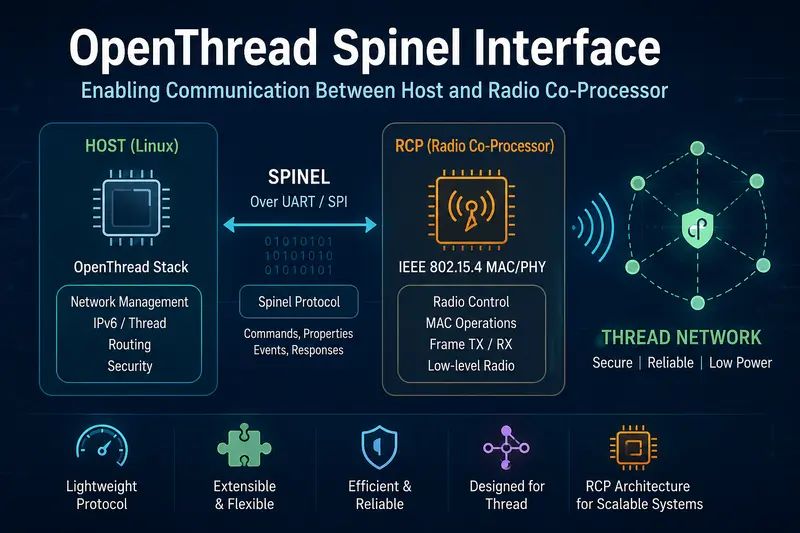
At a high level, Spinel is the communication protocol used between a host processor and a Thread radio device. In practice, that usually means a Linux system communicating with an IEEE 802.15.4 radio chip running OpenThread Radio Co-Processor firmware. Spinel acts as the bridge between the networking logic running on the host and the radio hardware responsible for transmitting and receiving Thread packets.
This architecture has become increasingly important as Thread evolves beyond tiny standalone embedded products. Early wireless systems often placed everything on a single microcontroller. The application, networking stack, security layer, and radio control all lived together inside one firmware image. That design still works for many low power products, but it starts becoming restrictive when devices grow more complex or need integration with Linux, Matter, Wi-Fi, Ethernet, cloud services, or containerized applications.
Modern smart home hubs and industrial gateways often need far more processing power than a small radio MCU can provide. They also need easier software updates, stronger debugging tools, and tighter integration with higher level networking services. OpenThread’s Spinel interface helps solve this problem cleanly by splitting responsibilities between a host processor and a radio subsystem, much in the same way as HCI does for Bluetooth.
Understanding Spinel helps explain how modern Thread Border Routers operate internally, why Radio Co-Processor designs became dominant, and how OpenThread scales from small embedded systems to powerful Linux gateways.
Why OpenThread Needed Spinel
To understand why Spinel exists, it helps to look at how wireless networking systems evolved over time.
In traditional embedded wireless products, the radio microcontroller handled nearly everything. The same MCU would manage the application logic, maintain the networking stack, perform encryption, process IPv6 packets, and control the IEEE 802.15.4 radio. This approach worked well because Thread networks originally targeted constrained devices with relatively simple requirements.
As the ecosystem matured, companies started building more advanced systems such as smart home hubs, Thread Border Routers, industrial gateways, and Matter controllers. These products frequently used Linux application processors capable of running sophisticated networking software and cloud services. At the same time, they still needed an IEEE 802.15.4 radio for Thread communication.
The challenge became figuring out how the Linux host should communicate with the radio subsystem efficiently.
Rather than forcing the entire Thread stack to run on the radio MCU, OpenThread introduced other architectures that separated the host from the radio hardware. Spinel became the protocol responsible for connecting those two pieces together.
Instead of exposing raw radio hardware registers directly to Linux, the radio device presents a defined interface using Spinel commands and properties. The host processor can configure the radio, send packets, receive packets, monitor network state, and control Thread operations through this protocol.
This separation turned out to be extremely valuable because it allowed Thread networking to integrate naturally into more powerful systems without dramatically increasing the complexity of the radio firmware itself.
The Difference Between NCP and RCP Designs
One of the most important concepts in OpenThread is understanding the distinction between Network Co-Processor mode and Radio Co-Processor mode. Spinel can operate with both architectures.
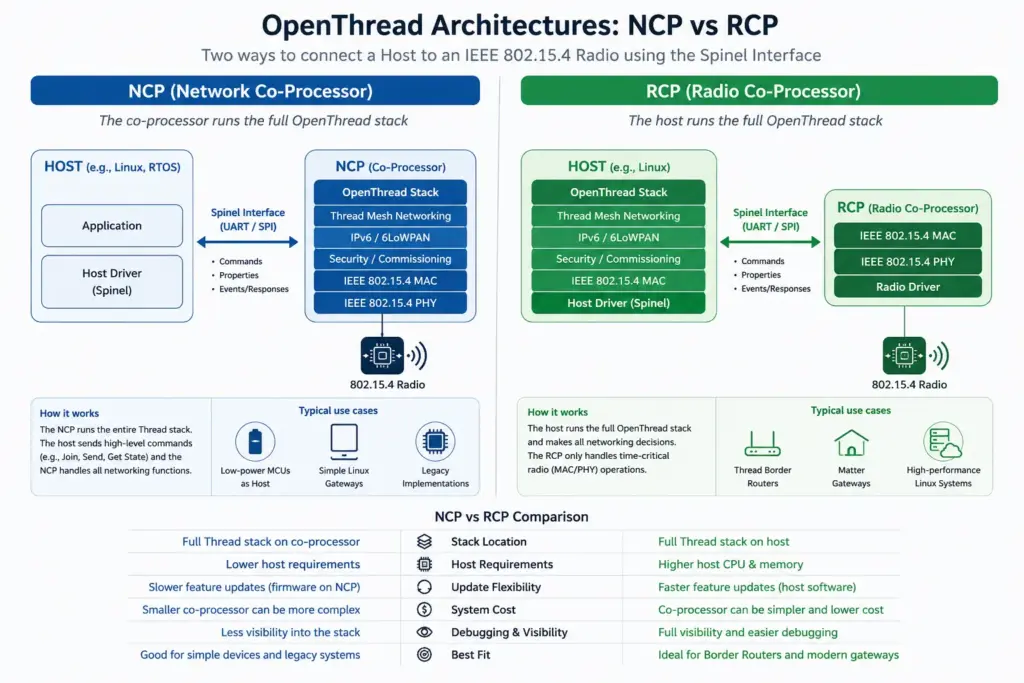
In Network Co-Processor mode, the Thread stack runs almost entirely on the co-processor itself. The host communicates with the device using relatively high level commands. The co-processor handles routing, mesh networking, security management, neighbor tracking, and most Thread protocol responsibilities internally.
This architecture reduces complexity on the host side because the Linux system doesn’t need to understand the entire Thread stack. Historically, older OpenThread integrations and tools such as wpantund commonly used this model.
Over time, however, the industry shifted toward Radio Co-Processor designs.
In an RCP architecture, the full Thread stack runs on the host processor instead of the radio MCU. The radio subsystem mainly performs timing sensitive MAC and PHY operations while the host handles Thread networking, IPv6 processing, routing decisions, and Matter integration.
This shift produced several important advantages.
First, the radio firmware becomes smaller and easier to maintain because it no longer carries the full networking stack. Second, Thread features can be updated on the host without constantly replacing radio firmware. Third, Linux-based Matter controllers integrate much more naturally because the networking stack already lives on the host processor.
Today, most commercial Thread Border Routers use RCP mode with Spinel serving as the communication layer between the host and the radio.
How the Spinel Interface Actually Works
At its core, Spinel is a lightweight binary protocol. The host sends commands to the radio subsystem, and the radio replies with responses or asynchronous notifications.
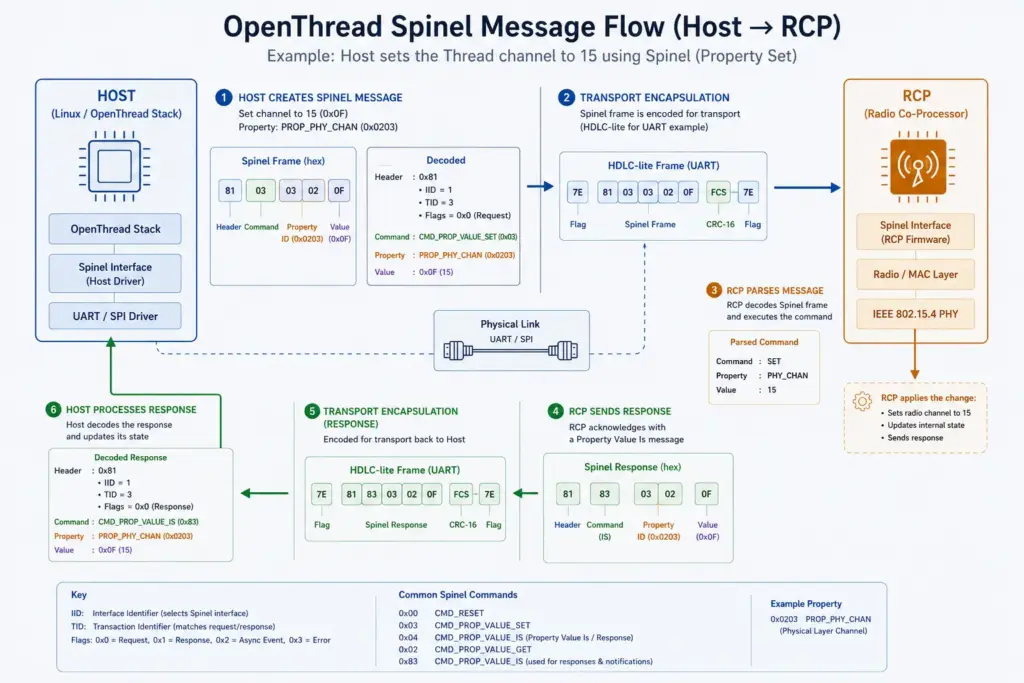
Unlike many traditional command interfaces, Spinel revolves heavily around properties. Instead of building massive command structures for every operation, OpenThread exposes device functionality through readable and writable properties.
For example, the host may request the current Thread role, configure the IEEE 802.15.4 channel, read the transmit power, retrieve the MAC address, or enable the radio by interacting with specific Spinel properties.
This property-based design gives the protocol considerable flexibility. New capabilities can be added without redesigning the entire protocol structure. Vendors can also introduce extensions while maintaining compatibility with the broader OpenThread ecosystem.
Internally, Spinel messages contain a compact binary structure that includes a header, a command identifier, and a payload section containing serialized data. Because embedded communication links such as UART often have limited bandwidth, the protocol was intentionally designed to minimize overhead.
The result is a transport-efficient interface that works well even on constrained embedded systems.
Why Spinel Became So Important for Border Routers
The rise of Thread Border Routers dramatically increased the importance of Spinel.
A modern Thread Border Router typically contains a Linux application processor connected to an IEEE 802.15.4 radio device through UART or SPI. The Linux system may simultaneously handle Wi-Fi, Ethernet, cloud services, Matter controllers, OTA updates, and local automation logic.
Trying to place all of those responsibilities onto a small radio MCU would create major scalability problems. By separating the networking stack from the radio hardware, OpenThread allows the host processor to manage the more complex software layers while the radio focuses on real-time wireless communication.
Spinel became the glue holding that architecture together.
In a Border Router environment, the host processor continuously exchanges Spinel messages with the radio subsystem. The radio reports received packets, energy scans, radio state changes, and MAC events. The host configures networking parameters, manages Thread state, and requests packet transmissions.
This communication happens constantly and usually remains invisible to end users. Yet without Spinel, the host and radio components would need proprietary interfaces that varied from vendor to vendor.
One reason Spinel succeeded is because it standardized this interaction layer across different hardware platforms.
UART and SPI Transport Layers
Although Spinel defines the messaging protocol itself, the data still needs to travel across a physical transport interface. The most common transports are UART and SPI.
UART became popular early because nearly every embedded platform supports serial communication. It’s simple, inexpensive, and easy to debug with common engineering tools such as logic analyzers and serial sniffers.
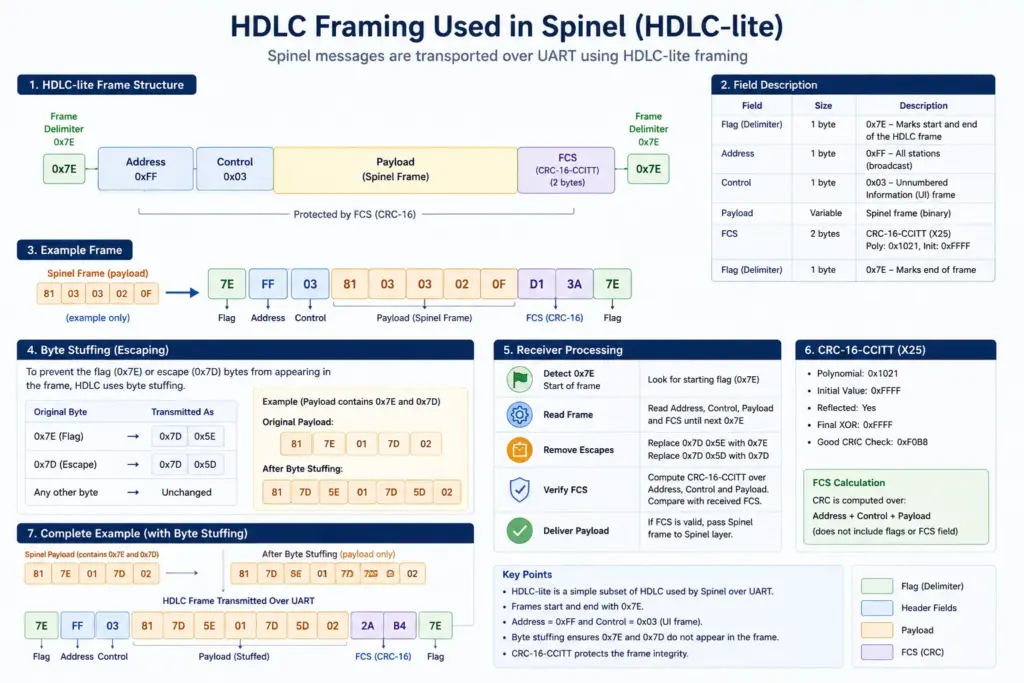
When Spinel runs over UART, OpenThread commonly uses HDLC-lite framing. This framing system helps define packet boundaries and prevents payload bytes from accidentally corrupting the serial stream structure. Special characters are escaped, and frame delimiters separate messages cleanly.
For lower traffic systems, UART performs well enough and keeps hardware design relatively simple.
As Matter and Thread deployments became more demanding, many vendors started moving toward SPI transport instead. SPI provides significantly higher throughput and lower latency than UART, which becomes important when handling heavier traffic loads or multiple simultaneous services.
SPI integration is more complex because it requires tighter synchronization between the host and the radio subsystem. Buffer management, interrupts, and flow control become more challenging. Even so, many commercial Border Routers now favor SPI because the performance advantages are substantial.
Spinel Properties and Protocol Design
One of the more elegant aspects of Spinel is how much functionality gets abstracted into properties.
Instead of building hundreds of unique commands, OpenThread exposes device behavior through standardized property identifiers. These properties may represent simple configuration values, large data structures, tables, or status information.
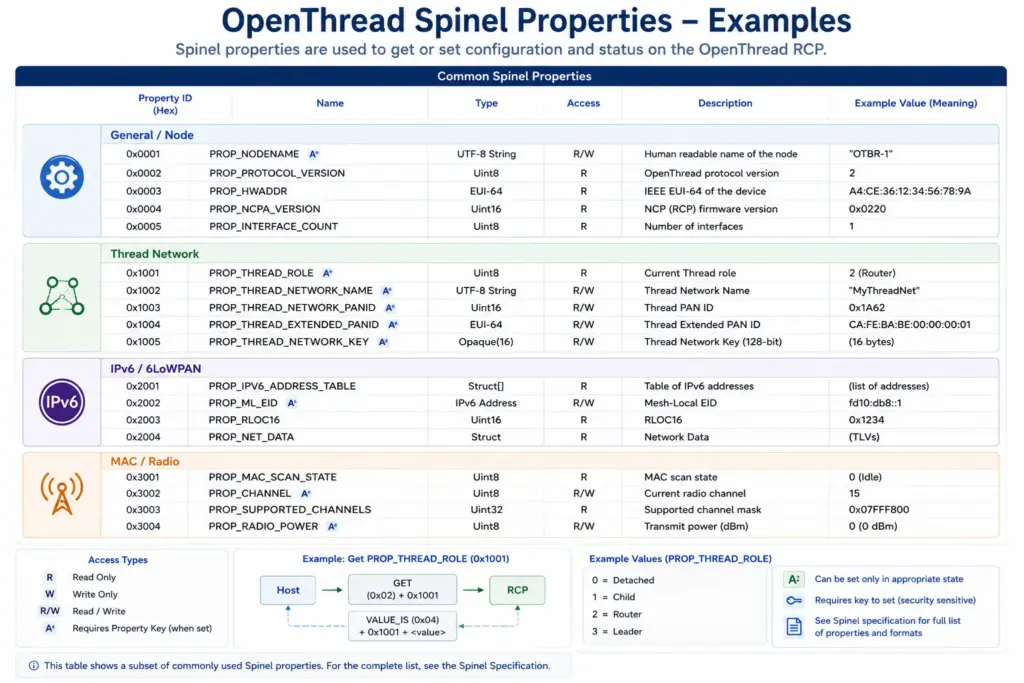
For example, properties can expose the current Thread role, IPv6 address tables, child device information, MAC configuration, or radio parameters. Some properties are read-only while others can be modified by the host.
This approach makes Spinel feel somewhat similar to a network device management interface rather than a traditional embedded serial protocol.
The design also simplifies extensibility. If OpenThread introduces new features later, developers can often expose them simply by defining additional properties instead of redesigning the entire command architecture.
Internally, Spinel uses compact binary serialization to encode these values efficiently. Since Thread networking frequently runs over constrained embedded interfaces, minimizing overhead matters significantly.
Spinel and Matter Integration
Matter helped accelerate adoption of RCP architectures and indirectly increased Spinel’s importance across the smart home ecosystem.
Matter controllers frequently run on Linux or relatively powerful application processors because they need enough resources for secure commissioning, device databases, cloud connectivity, and automation frameworks. Running the Thread stack directly on the host makes integration much easier than treating Thread networking as a completely isolated subsystem.
With Spinel, the Linux host can directly manage Thread operations while still using a dedicated IEEE 802.15.4 radio device for physical communication.
This architecture scales well because the radio firmware stays relatively lightweight while the host remains flexible and easier to update. Matter software evolves quickly, and moving most networking logic to the host simplifies long-term maintenance considerably.
Many commercial Matter hubs now use OpenThread with an RCP connected through Spinel internally, even if consumers never realize that architecture exists inside the product.
Debugging Spinel Interfaces
One of the realities of RCP architectures is that debugging becomes more distributed. Engineers are no longer dealing with a single firmware image. Instead, they have a host application stack, a transport layer, and a separate radio firmware implementation all interacting simultaneously.
When problems occur, developers often need visibility into the Spinel traffic itself. OpenThread itself provides some of the most useful Spinel debugging visibility.
You can enable verbose logs in:
- ot-br-posix
- ot-daemon
- wpantund
- RCP firmware
- POSIX OpenThread builds
These will enable you to see Spinel commands, Property transactions, RCP resets, Radio state changes, and Packet TX/RX activity among other things.
To enable this during a build, you can enable the right log level:
OT_LOG_LEVEL=DEBGSerial captures are commonly used to inspect UART communication between the host and the RCP. Engineers usually analyze HDLC frames, inspect property transactions, monitor packet timing, or observe asynchronous notifications flowing between the two systems.
Transport issues are among the most common failure points. UART flow control problems, framing errors, buffer overruns, or mismatched baud rates can all create unstable behavior that initially looks like networking failures.
Version compatibility can also become problematic. Since the host stack and RCP firmware evolve independently, mismatched versions may introduce subtle issues that are difficult to diagnose without detailed logging.
Security Considerations
Spinel itself isn’t designed as a secure encrypted protocol. In most deployments, this isn’t usually an issue because the interface typically exists in a device between internal processors.
Still, security remains important.
If an attacker gains physical access to the hardware or compromises the radio firmware, they may potentially interfere with Thread communications or extract sensitive information. Commercial products therefore frequently protect the radio subsystem using secure boot, signed firmware updates, flash encryption, or debug interface lockouts.
These protections become especially important in industrial and commercial deployments where the Thread network may control physical infrastructure or security-sensitive devices.
As Matter adoption grows, protecting the integrity of both the host processor and the RCP firmware becomes increasingly important because both participate in maintaining trusted communications.
Why Spinel Continues to Matter
Spinel became successful because it solved a real architectural problem at exactly the right time. The networking industry was moving toward Linux-based gateways and more sophisticated smart home controllers while still needing low power IEEE 802.15.4 radios.
Rather than forcing vendors into proprietary host-radio interfaces, OpenThread provided a standardized communication layer that worked across different platforms and hardware vendors.
That standardization made large ecosystems possible.
Today, Spinel quietly powers a huge number of Thread Border Routers, Matter controllers, and embedded gateway products. Most end users never hear the term, but engineers working on Thread systems interact with it constantly during development, debugging, and product integration.
As Thread and Matter deployments continue expanding, the role of Spinel will likely remain central for years to come. The combination of a powerful host processor and a lightweight radio subsystem has proven extremely practical, and Spinel remains the protocol enabling that architecture behind the scenes.
Conclusion
The OpenThread Spinel interface is one of the foundational technologies behind modern Thread networking systems. It allows a host processor and a radio subsystem to work together efficiently while keeping responsibilities cleanly separated.
By enabling Radio Co-Processor architectures, Spinel helped OpenThread scale from small embedded devices to Linux-based Border Routers and Matter hubs. The protocol’s lightweight binary design, property-based structure, and transport flexibility made it well suited for embedded networking environments where efficiency and interoperability matter.
For developers building Thread products, understanding Spinel provides valuable insight into how OpenThread systems operate internally. It also helps explain many real-world debugging scenarios, transport challenges, and performance considerations that appear when integrating Thread radios with Linux hosts or Matter frameworks.
Although most users will never directly see Spinel, it’s become one of the critical technologies quietly powering the growth of Thread and Matter networking across the connected device industry.