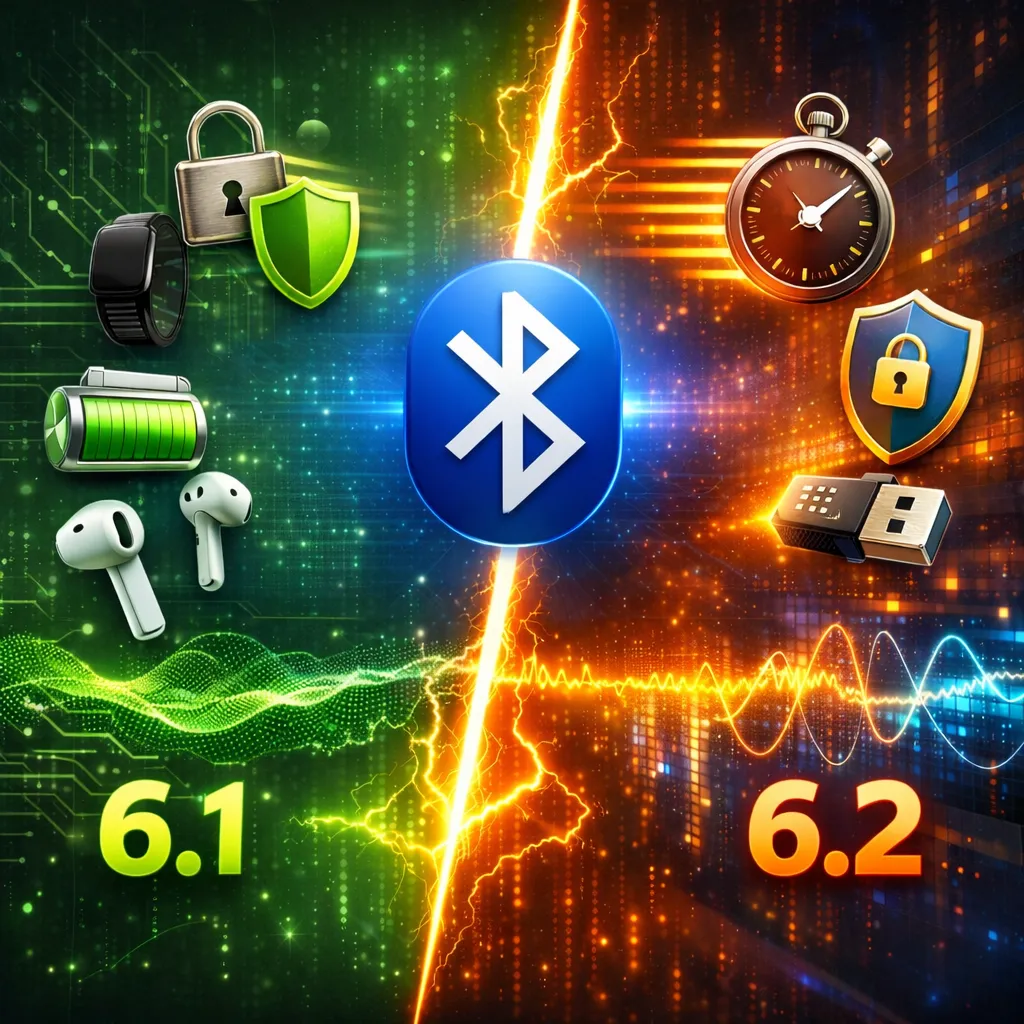
Bluetooth continues its rapid evolution with bi-annual specification releases from the Bluetooth Special Interest Group (SIG). After the major architectural release of Bluetooth 6.0 in 2024, versions 6.1 and 6.2 bring focused improvements—one emphasizing improved privacy and efficiency, the other adding responsiveness, security, and developer-centric enhancements.
We’ll unpack what each version adds, why it matters, and how these changes reflect the shifting needs of Bluetooth use-cases in 2025 and beyond.
Bluetooth 6.1: Privacy, Power Efficiency, and System Polishing
Released in May 2025, Bluetooth Core Specification 6.1 didn’t overhaul the protocol—but introduced important refinements to make Bluetooth connections more secure and energy-efficient.
Key Enhancements in Bluetooth 6.1
- Improved Privacy with Randomized RPA – Bluetooth devices now can change their Resolvable Private Address (RPA) at non-predictable intervals. This makes tracking devices via Bluetooth scanning much harder, protecting user privacy.
- Better Power Efficiency – The same randomized address behavior also reduces unnecessary wake-ups and radio activities on connected devices, contributing to longer battery life for accessories such as earbuds and wearables.
- Stronger Security and Efficiency Tweaks – While not as headline-grabbing as the core features of 6.0, 6.1 also includes minor enhancements around energy use and encryption management that refine the underlying Bluetooth LE experience.

In essence, 6.1 is an optimization release that makes Bluetooth LE connections less predictable (good for security) and more economical (good for power) without introducing big new capabilities.
Bluetooth 6.2: Latency, Responsiveness, Security, and Developer Tools
Just six months later, in November 2025, the SIG published Bluetooth Core Specification 6.2—a larger set of additions that expand both performance and developer capabilities.
Major Improvements in Bluetooth 6.2
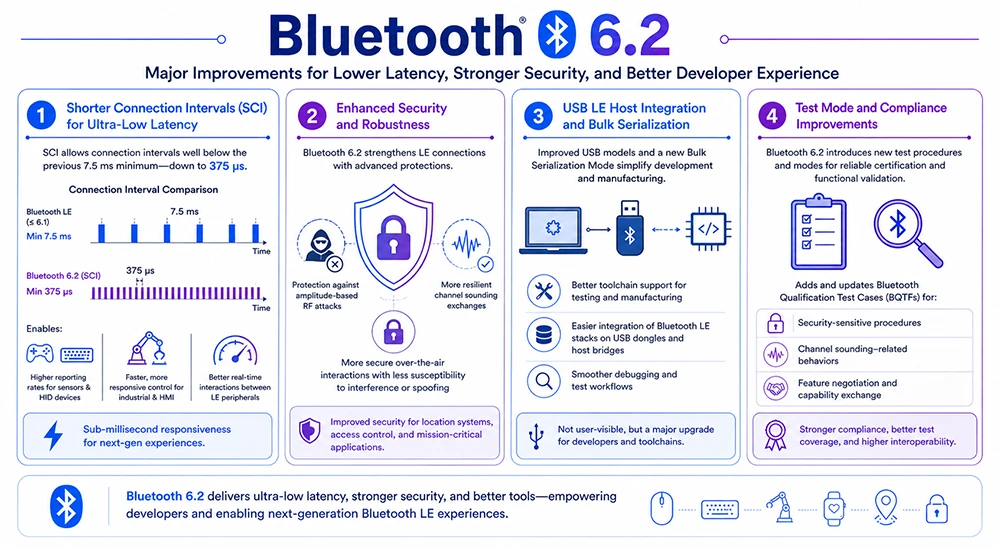
1. Shorter Connection Intervals (SCI) for Ultra-Low Latency
One of the most significant additions in 6.2 is the Shorter Connection Interval (SCI) feature, which allows Bluetooth LE connections to negotiate intervals well below the previous 7.5 ms minimum—down to 375 µs. This unlocks sub-millisecond responsiveness in connection events.
Lower latency enables:
- Higher reporting rates for sensors and HID devices (e.g., gaming mice/keyboards)
- Faster, more responsive control for industrial and HMI systems
- Better real-time interactions between Bluetooth LE peripherals
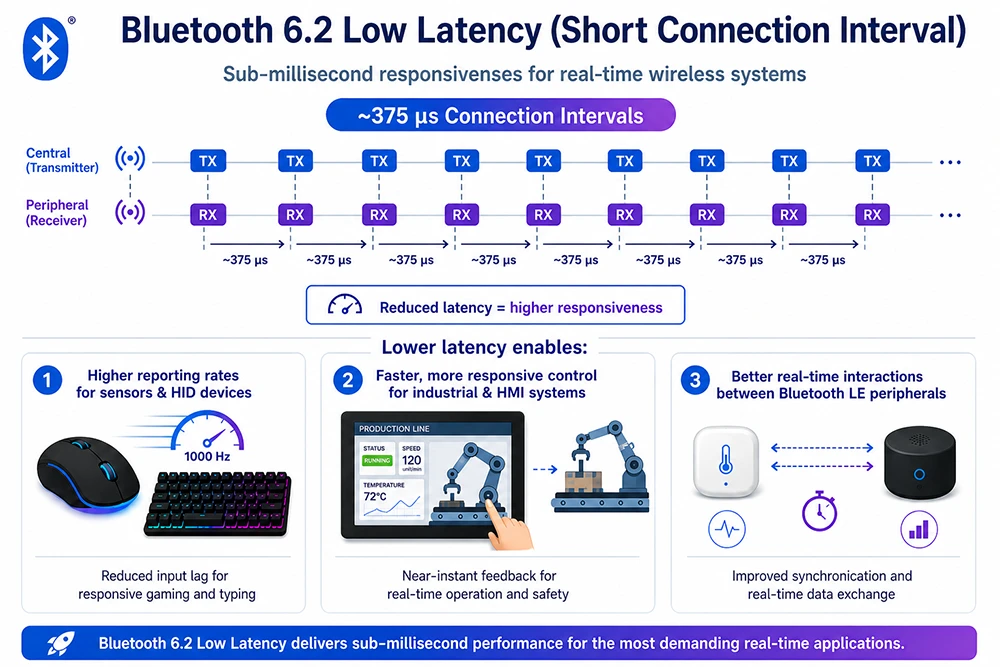
This is a foundational upgrade for use-cases that were previously challenging with Bluetooth LE’s timing constraints. If you’ve used a Bluetooth Mouse before, you may have noticed that it can often lag or not be as responsive as a wired mouse. The slow 7.5ms connection interval is one of the big reasons for this issue, and allowing faster intervals means you won’t need dongles with custom protocols.
There’s other applications that are also time sensitive that can take advantage of this feature.
2. Enhanced Security and Robustness
Bluetooth 6.2 continues the trend toward hardening LE channels, including protection against amplitude-based RF attacks and stronger resilience in channel sounding exchanges.
More secure over-the-air interactions with less susceptibility to interference or spoofing, which benefits location systems, access control, and mission-critical applications.
3. USB LE Host Integration and Bulk Serialization
For embedded developers and USB adapters, Bluetooth 6.2 defines improved USB control models and a new Bulk Serialization Mode.
- Better toolchain support for testing and manufacturing
- Easier integration of Bluetooth LE stacks on USB dongles and host bridges
- Smoother debugging/test workflows
This isn’t a user-visible feature, but it considerably improves the developer experience.
4. Test Mode and Compliance Improvements
The new Bluetooth 6.2 specification includes several new test procedures and modes to help certification and functional validation.
Bluetooth 6.2 adds and updates Bluetooth Qualification Test Cases (BQTFs), especially for:
- Security-sensitive procedures
- Channel sounding–related behaviors
- Feature negotiation and capability exchange
How Bluetooth 6.1 and 6.2 Fit in the Bluetooth Evolution
To appreciate the scope of these updates, remember that Bluetooth 6.0 laid a new architectural foundation: improved channel sounding (precise ranging), smarter advertising filtering, negotiable frame spacing, and broader link layer feature exchange.
Bluetooth 6.1 then refined that foundation with privacy and efficiency improvements, while Bluetooth 6.2 leveraged it to expand capability—especially in low-latency communication and developer tooling.
Conclusion
Bluetooth 6.1 and 6.2 exemplify a modern release cadence: incremental improvements that balance quality-of-life, security, and performance. While 6.1 focuses on tightening privacy and efficiency, 6.2 pushes the boundaries of responsiveness and developer experience. Together, they refine the Bluetooth ecosystem and expand the types of applications that LE can reliably support.
If you’re building next-generation Bluetooth products—especially in areas like gaming peripherals, industrial control, or real-time sensor networks — 6.2’s shorter intervals and enhanced security are especially worth evaluating for your stack, though it will take some time for vendor stacks to begin supporting the features.