Today the Bluetooth SIG announced the adoption of Bluetooth 7. As is the case with Bluetooth versions that change the major number, Bluetooth 7.0 introduces High Data Throughput, a huge increase in the data rate which is going to revolutionize Bluetooth Low Energy, along with several other features. At a high level the
- HDT with 7.5Mbps Throughput
- Encryption Production Debugging
- LE Isochronous Parameter Update
- Transient Application Key
High Data Throughput
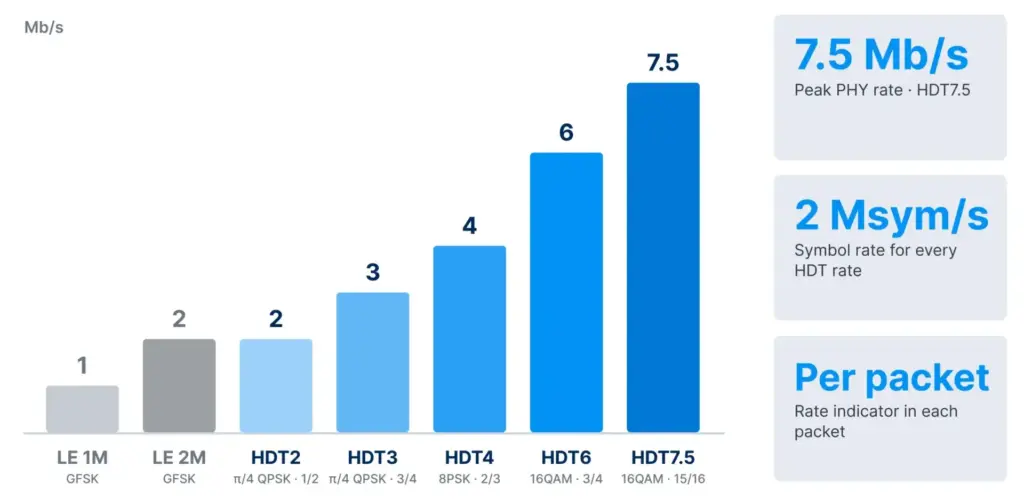
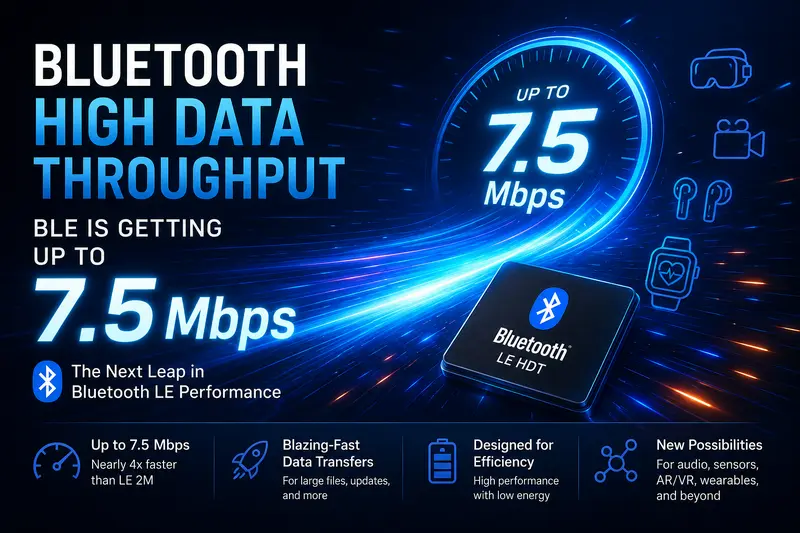
The most highly anticipated change in this release, HDT takes Bluetooth LE from 2Mbps up to 7.5Mbps, allowing higher throughput Data and Audio to run faster.
We covered HDT a bit in our Bluetooth High Data Throughput (HDT) article. Well, it’s finally official.
HDT is a massive change that requires LE radio support from the PHY to the Host, enhanced CPU capabilities to deliver the throughput.
The LE HDT is a new PHY, similar to the new 2Mbps PHY introduced in Bluetooth 5.0 that includes HDT2, HDT3, HDT4, HDT6, and HDT7.5.
However, not all the new HDT options are when claiming HDT compliance. An HDY Controller can avoid supporting HDT6 and HDT7.5 which lets smaller devices avoid the complexity of supporting these modes.
| HDT rate | Bit rate | Status for an HDT controller |
|---|---|---|
| HDT2 | 2 Mbps | Mandatory |
| HDT3 | 3 Mbps | Mandatory |
| HDT4 | 4 Mbps | Mandatory |
| HDT6 | 6 Mbps | Optional |
| HDT7.5 | 7.5 Mbps | Optional; supporting it also requires HDT6 |
How Devices use HDT
Devices connect first via a standard LE connection using a GFSK 1M PHY. Only then do they negotiate a switch to HDT. They can also move back to GFSK when conditions call for it like a drop in the link quality because of range or interference.
HDT doesn’t support advertising, so discovery and connection setup remain on GFSK. A LE Legacy device can still connect using ordinary LE, but it can’t use HDT unless both devices support it.
HDT adapts the rate from packet to packet. The control header sent in each packet carries information about the format , and it uses the more robust π/4 QPSK modulation so the receiver can decode that information before handling the higher-rate payload. There’s also an optional link-quality feedback feature that lets the receiver report channel conditions to help guide adaptation.
Packets, Reliability, and Security
HDT defines three packet formats: Short for acknowledgments or synchronization, PF0 for a simpler single-block payload, and PF1 for larger transfers. PF1 can combine up to four payloads and split them into blocks, allowing a device to retransmit only blocks that were lost or corrupted. PF1 is an optional capability; its listed maximum payload is 8,175 bytes and is designed for large and fast transfers.
Encryption Production Debugging
If’ you’ve debugged LE connections before, you’ll know that once you enable security things get a lot harder. You need to fish out the LTK information in order to be able to see what’s happening. That’s pretty inconvenient because you usually have to jumps through a lot of hoops to get it. And it changes, making it hard.
Some vendors implemented a debug key that would fix the key. But people sometimes forgot to change it, and that supposed security security.
Encryption Production Debugging is a feature to enable debugging encrypted Bluetooth links (including high data throughput links) during development, qualification, and production testing. It lets you do link-layer debugging and packet inspection while preventing security vulnerabilities (such as shipping production devices with fixed, sample, or debug encryption.
LE Isochronous Parameter Update
An isochronous stream (ISO) carries time-sensitive data such as audio in scheduled events. Without the LE Isochronous Parameter Update (IPU) feautre, Bluetooth keeps the negotiated CIS schedule for the life of the stream. If you wanted to change the parameters it would require ending and re-establishing the CIS connection which is disruptive.
IPU helps the system change the timing and delivery parameters on an established CIS instead. That could let an application adjust to a new data rate or latency requirement need without a full stream restart.
The handoff still has to preserve packet order: packets from the old schedule have to be delivered or reported lost, while the new schedule starts at the agreed instant. Bluetooth has an independent IPU selection and passing software tests for bounded changes in flush timeout, burst cadence, interval, and multi-CIS coordination.
Transient Application Key
Before Transient Application Key (TAK), an application that wanted LE link encryption generally relied on the Bluetooth pairing. It could also protect data using its own protocol, but Bluetooth could not use an application-authenticated temporary secret as that connection’s LE traffic key. the Transient Application Key feature provides that handoff and lets the LE traffic be encrypted with that application later.
With TAK, an application on each device first authenticates its peer and establishes the same temporary secret with 128-bit security strength. Then it asks Bluetooth to use it for one connection without creating a bond. Bluetooth requires an application authentication verifier before accepting the key.
TAK is useful when a higher-layer protocol already authenticates the peer and needs a short-lived (hence transient) encrypted Bluetooth session without creating a persistent bond. It doesn’t automatically unlock every protected service: a profile has to explicitly allow TAK for its ATT attributes or LE Credit Based Channels, and protected
requests wait for actual encryption rather than treating key submission as success.
A failed refresh, disconnect, or reused connection handle removes the old authorization. The explains what the application must verify and how the key is bound to a connection lifetime. Radio-integrated operation and the application’s own authentication protocol need separate validation.